
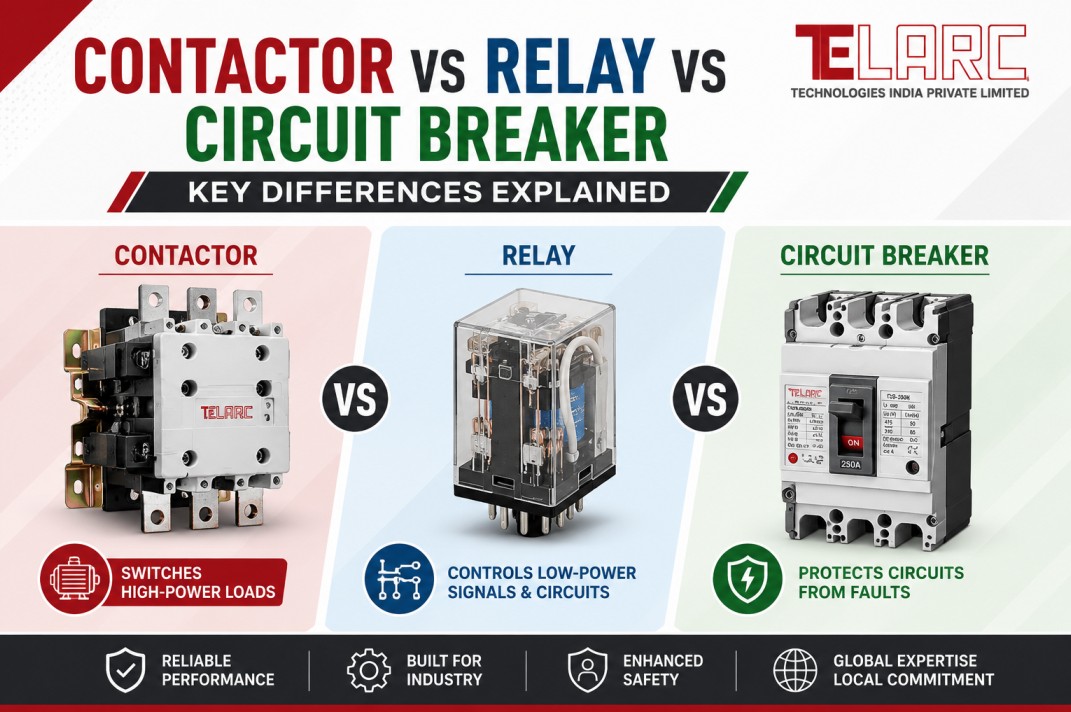
Electrical systems rely on various switching and protection devices to ensure safe, reliable, and efficient operation. Among the most commonly used components are contactors, relays, and circuit breakers. While these devices may appear similar at first glance, each serves a unique purpose in industrial, railway, power, renewable energy, and automation applications.
Understanding the differences between contactors, relays, and circuit breakers is essential for selecting the right component for your electrical system. In this guide, we explain how each device works, their applications, and the key differences between them.
What is a Contactor?
A contactor is an electrically controlled switching device designed to switch high-current electrical loads on and off. Contactors are commonly used in industrial machinery, railway systems, motors, HVAC equipment, and power distribution applications.
Key Features of Contactors
- Designed for frequent switching operations
- Handles high current and voltage loads
- Equipped with arc suppression mechanisms
- Typically used for motors, transformers, and power circuits
- Available in AC and DC configurations
Common Applications
- Railway traction systems
- Industrial motor control
- Power distribution systems
- Renewable energy installations
- E-mobility charging infrastructure
What is a Relay?
A relay is an electrically operated switch that uses a low-power signal to control another electrical circuit. Relays are generally designed for lower current applications and are commonly used in automation, control panels, signaling systems, and electronic circuits.
Key Features of Relays
- Controls circuits using low-power signals
- Suitable for low-current applications
- Compact design
- Provides electrical isolation between circuits
- Available in electromechanical and solid-state versions
Common Applications
- PLC and automation systems
- Control panels
- Protection circuits
- Communication systems
- Signaling equipment
What is a Circuit Breaker?
A circuit breaker is a protective device designed to automatically interrupt electrical current when abnormal conditions such as overloads, short circuits, or faults occur.
Unlike contactors and relays, circuit breakers primarily provide protection rather than routine switching.
Key Features of Circuit Breakers
- Protects electrical systems from faults
- Automatically disconnects power during overload conditions
- Can be manually reset after a fault
- Available in low-voltage, medium-voltage, and high-voltage designs
- Essential for electrical safety
Common Applications
- Power plants
- Railway electrical systems
- Industrial facilities
- Commercial buildings
- Electrical substations
Contactor vs Relay vs Circuit Breaker: Comparison Table
| Feature | Contactor | Relay | Circuit Breaker |
|---|---|---|---|
| Primary Function | Switching Power Loads | Signal Switching & Control | Circuit Protection |
| Current Capacity | High | Low to Medium | High |
| Switching Frequency | Very High | Moderate | Low |
| Fault Protection | No | Limited | Yes |
| Motor Control | Excellent | Limited | Not Intended |
| Automation Systems | Common | Very Common | Rare |
| Industrial Applications | Extensive | Control Systems | Protection Systems |
| Manual Operation | No | No | Yes |
When Should You Use a Contactor?
Choose a contactor when:
- Controlling motors or heavy electrical loads
- Frequent switching is required
- Railway or industrial applications are involved
- High current handling is necessary
- Long operational life is important
For example, railway traction systems and industrial manufacturing plants rely heavily on contactors for safe and reliable switching operations.
When Should You Use a Relay?
Choose a relay when:
- Low-power control signals are involved
- Circuit isolation is required
- Automation and control applications are present
- Compact switching solutions are needed
Relays are commonly found in PLC systems, instrumentation, and electronic control circuits.
When Should You Use a Circuit Breaker?
Choose a circuit breaker when:
- Electrical protection is required
- Preventing equipment damage is critical
- Overload and short-circuit protection is needed
- Compliance with safety standards is necessary
Circuit breakers form the backbone of electrical protection systems across industries.
Importance in Railway and Power Applications
Modern railway and power infrastructure depends on all three devices working together.
- Contactors manage traction and auxiliary systems.
- Relays handle signaling and control functions.
- Circuit breakers protect equipment from electrical faults.
This coordinated approach ensures operational reliability, safety, and efficiency in critical infrastructure environments.
Conclusion
Although contactors, relays, and circuit breakers are all switching devices, they serve fundamentally different purposes.
- Contactors are designed for switching high-power electrical loads.
- Relays are intended for low-power control and signal switching.
- Circuit breakers provide protection against electrical faults and overloads.
Selecting the right device depends on your application’s switching requirements, current levels, and protection needs. For industries such as railways, power generation, renewable energy, and industrial automation, understanding these differences is essential for building safe and efficient electrical systems.
About Telarc Technologies India Pvt Ltd
Telarc Technologies India Pvt Ltd delivers advanced electrical switching solutions for railways, power systems, renewable energy, and industrial applications. Our product portfolio includes high-performance contactors, disconnectors, circuit breakers, and specialized switching solutions engineered for reliability, safety, and long-term performance.